


| INTRODUCTION |
The properties of Specially Concentric Braced Frames (SCBF) systems have the potential to meet multiple performance objectives. However, previous research has shown that the current design procedures can lead to soft stories, inadequate gusset plate connections, unexpected failure modes, brittle welds and premature brace failure. To improve the performance and to meet the engineering needs of future seismic load resisting systems, an international research team is working to develop Tomorrows Concentric Braced Frame (TCBF) systems. This research team receives support from the NEES program and the National Science Foundation with a NEESR Small Group project entitled "International Hybrid Simulation of Tomorrows Braced Frame Systems". The international team of collaborators includes researchers from the University of Washington (UW), the University of California Berkeley (UCB), the University of Minnesota (UM) and the NCREE Laboratory in Taiwan. Researchers from Japan, Canada, industry professionals and practicing engineers are also collaborating on this project.
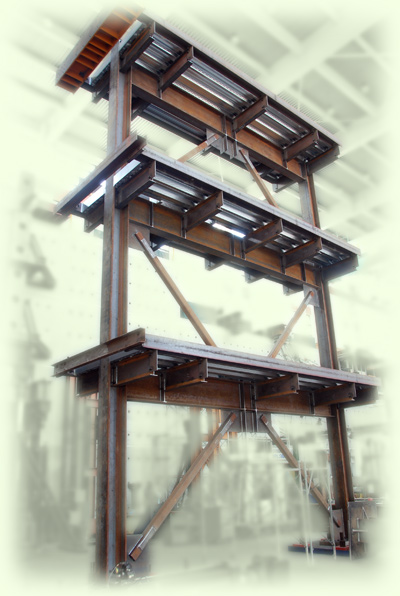
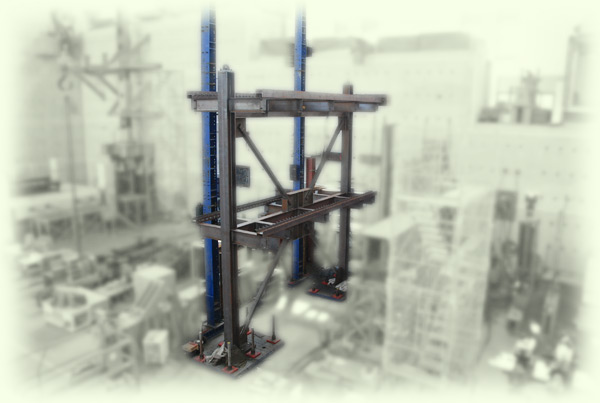
This is the second phase of testing done at the NCREE laboratory. The first phase of testing involved three tests done on a two bay, two story SCBF specimen. Two of the three tests in the first phase used a balanced design procedure that relied on cyclic yielding of the brace while permitting distributed yielding into the gusset plates and framing elements to maximize the drift capacity of the system. Finally in the first phase, one test was conducted on a SCBF that was designed per current design practices of engineers. The second phase of testing involves a three story, two bay SCBF specimen. Several tests are planned with this frame that also rely on the balanced design procedure and other improved SCBF design techniques. All of these tests will be performed at the NCREE laboratory under the guidance of Professor K.C. Tsai with collaboration from his U.S. colleagues. Finite element models created for these three story specimens will be verified using the test data generated in these series of experiments.
|
© 2007 2008 2009 National Center for Research on Earthquake Engineering